Research·
AI Model IRIS Decodes the Language Cells Use to Communicate
MIT researchers unveil IRIS, a machine‑learning system that reads the unique gene‑activity fingerprints left by signaling pathways, enabling cross‑cell‑type reconstruction of developmental histories.
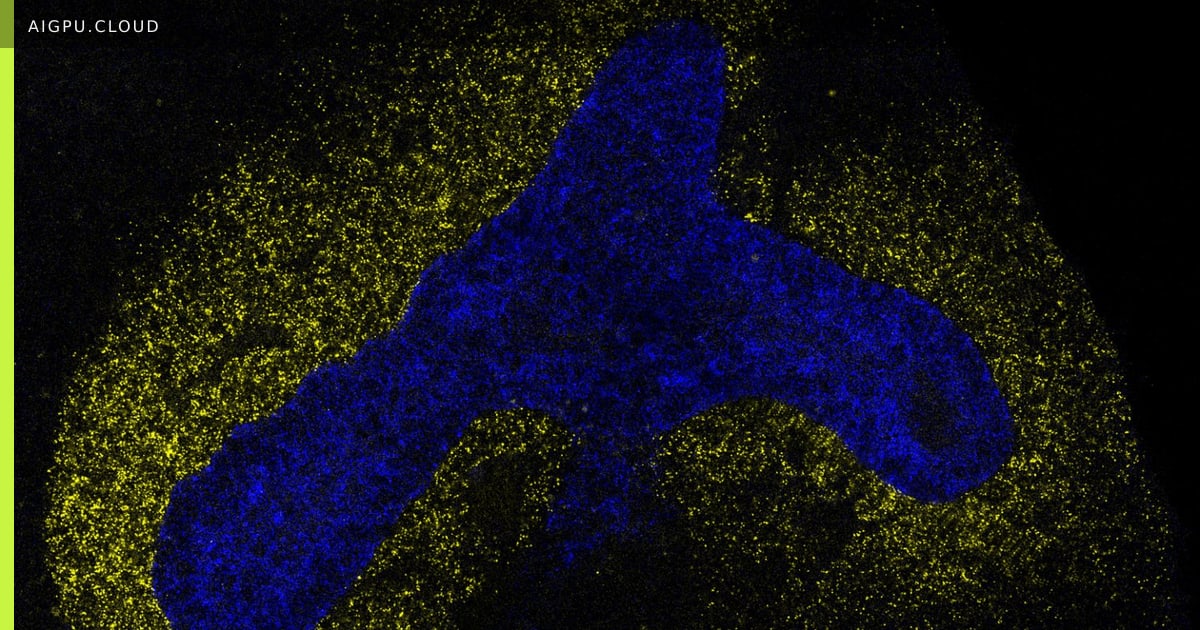
During embryogenesis, stem cells exchange chemical cues that steer them toward distinct identities and three‑dimensional architectures. Mapping the full sequence of these signals has traditionally required painstaking, cell‑type‑by‑cell‑type experiments.
A team led by MIT biologist Pulin Li and graduate student Nicholas Hutchins discovered that each signaling pathway leaves a consistent “fingerprint” — a characteristic pattern of gene expression — across many cell types. Their machine‑learning model, named IRIS, learns these fingerprints once and then recognizes them in unseen cell populations.
Why it matters for GPU / AI infrastructure
IRIS exemplifies transfer learning: a model trained on a limited set of pathways generalizes to new contexts without exhaustive retraining. This reduces the volume of labeled data and compute cycles needed, but the initial training still demands large‑scale GPU clusters for high‑throughput single‑cell sequencing analysis.
For cloud providers like AiGpu, the workload profile — massive matrix operations on sparse genomic matrices, mixed‑precision training, and rapid inference across thousands of samples — aligns directly with the capabilities of modern AI‑optimized GPU instances.
The open‑access study, published in Nature Methods, offers a reproducible pipeline that can be deployed on scalable GPU infrastructure to accelerate stem‑cell engineering, disease modeling, and therapeutic discovery.
- aigpu
- ai gpu
- ai gpu cloud
- aigpu dubai
- machine learning
- computational biology
- transfer learning
- biomedical ai
By AiGpu Editorial · Editorial rewrite based on public reporting (MIT News AI)
← All articles