Infrastructure·
Google’s Tabletop AI experiment lets you build custom collaboration apps
Google Labs has launched Tabletop, an experimental AI platform that lets users describe and generate personalized collaborative workspaces for tasks such as itinerary planning, expense splitting, and chore management.
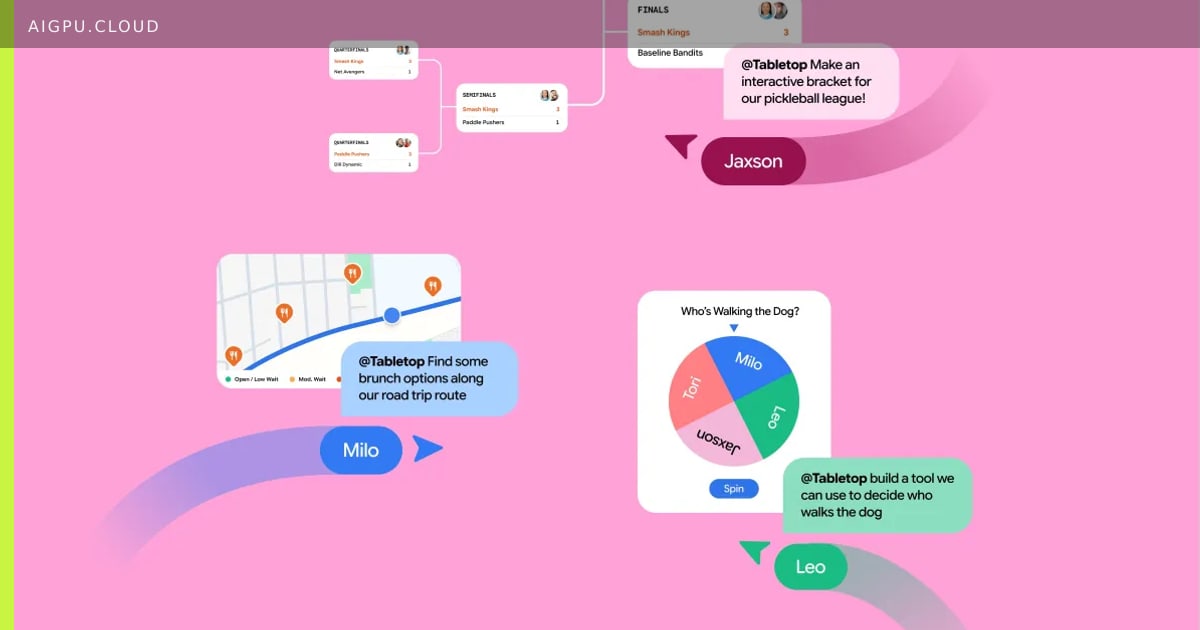
How Tabletop Works
The new Tabletop service from Google Labs uses generative AI to turn natural‑language prompts into interactive collaboration hubs. Users can request tools such as savings trackers, event planners, or tournament brackets, and the system creates the corresponding widgets automatically.
Once a space is generated, an invite link can be shared in any chat, allowing multiple participants to edit and use the same live interface simultaneously, much like a Google Doc.
Access is currently limited to a waitlist and to users aged 18 and over in the United States, but the underlying AI models run on Google’s GPU‑accelerated infrastructure, signalling growing demand for high‑performance AI compute.
For GPU and AI infrastructure planners, Tabletop illustrates a emerging workload that leverages large language models and real‑time interactivity, potentially influencing GPU utilization patterns and hardware procurement strategies in cloud and enterprise environments.
- aigpu
- ai gpu
- ai gpu cloud
- aigpu dubai
- collaboration
- generative ai
- cloud ai
By AiGpu Editorial · Editorial rewrite based on public reporting (The Verge AI)
← All articles